Structural Drying and Dehumidification in Flowery Branch, GA
Structural drying in Flowery Branch, GA dries framing, subfloor, drywall and concrete with air movers and LGR or desiccant dehumidifiers, and the drying team logs readings until materials reach the IICRC S500 drying goal.
(888) 532-4616House wet inside the walls? Get it dried right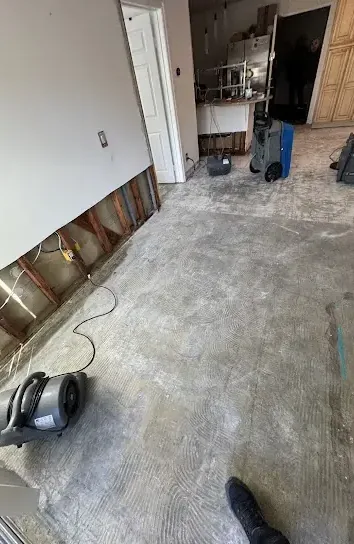
First moves for structural drying and dehumidification
- 1
Close the windows
Humid outside air slows drying.
- 2
Run the AC steady
Keep the house cool and closed up.
- 3
Leave equipment on
Switching units off resets the clock.
- 4
Keep doors as set
Air movers are aimed for each room.
The standard behind every structural drying and dehumidification job
Dispatch at any hour
Active water is treated as urgent around the clock, because drywall and pad keep wicking until extraction starts.
Dried to a reading
The drying team works to the IICRC S500 standard and pulls equipment only when the meters say dry.
A file the adjuster can use
Moisture maps, daily psychrometric logs and timestamped photos are taken before anything is torn out.
Built for Piedmont houses
Clay lots, walkout basements, crawl spaces and attic air handlers shape how water moves in these homes.
What does structural drying and dehumidification cost in Flowery Branch, GA?
Structural drying usually runs $1,200 to $8,000 or more as part of a water loss. One room of Class 1 drying is the low end; Class 4 hardwood or concrete drying across several rooms is the high end. Category, square footage, materials and drying speed set the number.
| Size of the loss | Typical range | What it usually covers |
|---|---|---|
| One room, Class 1 or 2 | $1,200 to $2,800 | Air movers, LGR dehumidifier, Three to five days |
| Several rooms, Class 3 | $2,800 to $5,500 | Wall cavity drying, More equipment, Daily logs |
| Class 4 materials | $5,500 to $8,000+ | Hardwood or concrete, Desiccant units, Drying mats |
Ranges are typical, not a quote: the water category, square footage, material class and how fast drying started move the number most. Run the water damage cost calculator for a closer planning figure.
The structural drying and dehumidification process from first reading to dry
- 1
Map
Moisture mapped and class set.
- 2
Place
Air movers and dehumidifiers sized.
- 3
Log
Readings and psychrometrics daily.
- 4
Verify
Out at 2 to 4 points of dry.
Surface drying makes a room look finished; structural drying makes it actually dry. In the humid lake country air around Flowery Branch, wet framing and subfloor can stay damp for weeks unless the moisture is pulled out on purpose and measured every day.
What the drying class decides
IICRC S500 sorts a loss into Class 1 to 4 by how much water was absorbed and what materials took it in. The class sets how many air movers and how much dehumidification a room needs.
- Class 1 and 2: carpet, pad and drywall
- Class 3: water to the ceiling or overhead
- Class 4: hardwood, plaster and concrete
Class 4 materials often need desiccant dehumidifiers or specialty drying mats.
Walls still reading wet days after the leak? Moisture left in framing keeps feeding the damage.
(888) 532-4616Get the framing back to dryHow drying is measured
The drying team logs temperature, relative humidity and grains per pound inside and outside the drying area, plus readings on wet materials. Equipment is moved or added when the numbers stall.
- Daily psychrometric logs
- Moisture readings on framing and subfloor
- A dry reference in the same house
Dry means 2 to 4 points
Materials are dry when they read within 2 to 4 points of the same material in an unaffected part of the house, not when they feel dry to the touch.
Why humid summers slow drying
Georgia summer air holds a lot of moisture, so open windows can work against the dehumidifiers. Drying runs best with the house closed up and the air conditioning steady.
The EPA indoor air quality pages explain indoor humidity, and UGA Extension publishes moisture advice for Georgia homes.
Structural drying and dehumidification across Flowery Branch and south Hall County
One dispatch covers every neighborhood listed here, around the clock.
The response team covers ZIP 30542 from the historic downtown by the depot and the Lake Lanier shoreline out to Spout Springs, McEver Road along Mud Creek, Falcon Crest Drive and Chestnut Mountain.
Nearby coverage reaches Buford, Gainesville, Sugar Hill, Cumming, Suwanee, Oakwood and Braselton.
Structural Drying and Dehumidification questions in Flowery Branch, GA
What is structural drying?
It is drying the building itself, framing, subfloor, drywall and concrete, not just the surfaces. Air movers and dehumidifiers are sized to the class of loss, and readings prove when materials are dry.
How long does structural drying take?
A Class 1 room usually dries in three to five days. Class 3 and Class 4 losses, with water in walls, hardwood or concrete, take longer. Equipment stays until readings reach the drying goal.
Can structural drying equipment be turned off at night?
It should stay on. Turning air movers and dehumidifiers off lets moisture settle back into the materials and stretches the drying time, which adds days to the job.
What does the IICRC S500 drying goal mean for structural drying?
Wet materials are considered dry when they read within 2 to 4 points of the same material in an unaffected part of the house. The drying team logs that comparison daily.
Is structural drying covered by insurance?
When it follows a covered loss, such as a sudden pipe break, drying is usually part of the claim. Daily psychrometric logs and readings support the scope. Coverage depends on your policy, so check with your own insurer.
Wet inside the walls? Get structural drying set up now.
Air movers and dehumidifiers go in at each room's load, and the drying team logs readings until materials are dry.