
When sewage comes up in a lower-level bathroom or a floor drain, the first question is often who is responsible. In the Gwinnett County part of Suwanee, the answer depends on which piece of the sewer connection failed. Some pieces belong to the County and some belong to the owner, and a missing valve can change who bears the damage.
Key takeaways
- In Gwinnett County the property owner maintains the private sewer lateral that connects the home to the public sewer.
- County standards require a cleanout at the right-of-way, which the County maintains, and a second cleanout closer to the home belongs to the owner.
- Georgia plumbing code requires a sanitary backwater valve when the lowest fixture is below the next upstream manhole, and the owner maintains it.
- If a required valve is missing, Gwinnett County is not responsible for damage from a sewage backup in the main.
- These are Gwinnett County rules, and the part of Suwanee that lies in Forsyth County should be checked separately.
The pieces of a sewer connection
The Gwinnett County Department of Water Resources manages and maintains the publicly owned water, sewer and stormwater infrastructure in the county. The pipe that leaves a house and meets the public sewer is a separate piece, and it has its own owner.
When something fails, the first task is working out which piece it was. That tells the household who handles the repair and what records matter.
Stormwater runs in a separate system, so a clogged storm drain in the street is a different problem from a sewer backup in the house.
- The public sewer main, managed by Gwinnett County
- The cleanout at the right-of-way, which the County maintains
- The private sewer lateral, maintained and operated by the property owner
- A second cleanout closer to the home, which belongs to the owner
- A sanitary backwater valve where one is required, maintained by the owner
The backwater valve rule
A backwater valve is a one-way gate in the sewer pipe. It lets wastewater out and keeps sewage from coming back in.
An owner who has a valve should know where it is and whether its access cover is clear. A valve that is buried, painted over or blocked with debris cannot be checked or serviced.
What the code requires
Georgia plumbing code requires a sanitary backwater valve between the home and the public sewer when the lowest plumbing fixture is below the next upstream manhole. The homeowner maintains the valve.
What happens when the valve is missing
If a required backwater valve is missing, Gwinnett County is not responsible for damage from a sewage backup in the main.
That makes the valve a question worth asking before a backup, and not after.
What this means for a lower-level bathroom or drain
A bathroom, laundry sink or floor drain that sits below the next upstream manhole is the situation the code is written for. When the main fills, sewage looks for the lowest opening, and that is often a floor drain or a shower.
A basement flooding cleanup follows the same pattern whether the water came from a storm or from the sewer: pump it out, remove what cannot be cleaned and dry the rest. Sewage adds contamination to every step.
A plumber can say whether a fixture sits below the next upstream manhole and whether a valve is already in the pipe run. That answer is worth having before the next heavy use of the sewer.
- Sewage coming up in the lowest tub, shower or floor drain
- Gurgling when a washer drains or a toilet is flushed
- Water backing up in more than one fixture at once
Maintenance steps Gwinnett County advises
Gwinnett County advises owners on keeping the lateral in good shape. The steps are simple and take little time.
- Locate the lateral cleanout on the property
- Keep its cap in good condition
- Have the lateral inspected by a plumber
- Avoid planting deep-rooted trees or shrubs near the lateral
One drain or the whole house
How many fixtures are affected points to where the blockage sits. A slow tub or sink is usually a local clog, while several fixtures backing up together points toward the lateral or the main.
That distinction matters because the lateral belongs to the owner and the main belongs to the County.
- One slow drain: usually a clog in that fixture
- Several slow drains: a clog in the lateral is more likely
- Sewage in the lowest drain when upstairs fixtures run: the lateral or main is blocked
- Neighbors with the same problem: the main may be involved
The part of Suwanee in Forsyth County
Suwanee extends into southeastern Forsyth County, and some addresses with a Suwanee mailing address lie in unincorporated Gwinnett or Forsyth County outside the city limits.
The rules above come from sources that describe Gwinnett County. Owners in the Forsyth County part should check with their own utility instead of assuming they apply.
- Check the city limits status of the address before relying on any city or county rule
- Ask the utility named on the bill who maintains the lateral and any valve
- Keep the answer in writing with the records for the home
When a backup has already happened
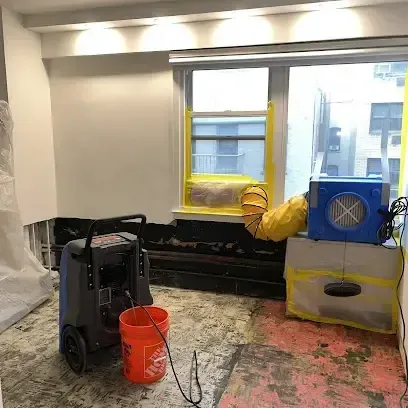
Sewage is contaminated water, usually called Category 3. A sewage backup cleanup removes the water, takes out porous materials that touched it and cleans and dries what remains.
The overview of sewage backup cleanup shows how that work is staged from extraction to drying.
The water often arrives in one room and spreads under walls and flooring. Moisture readings after extraction show how far it went and what must be opened up.
- Stop using water in the house until the cause is found
- Keep children and pets out of the affected area
- Photograph the damage and the cleanout before anything is moved
- Note whether a backwater valve is present and what condition it is in
- Read the insurance policy for sewer or drain backup wording
Questions
Who pays for damage when sewage backs up in a Suwanee home?
In Gwinnett County the owner maintains the lateral, and if a required backwater valve is missing the County is not responsible for damage from a backup in the main. Insurance wording decides much of the rest, so read the policy.
How do I find the sewer cleanout?
County standards require a cleanout on the lateral at the right-of-way, and a second cleanout sits closer to the home. They are capped pipe openings, so look near the edge of the property and near the house.
Does every home need a backwater valve?
Georgia plumbing code requires one when the lowest plumbing fixture is below the next upstream manhole. A plumber can check whether a particular home is in that situation.
Why avoid deep-rooted plants near the lateral?
Gwinnett County advises owners to avoid planting deep-rooted trees or shrubs near the lateral. Roots can find small cracks and grow into a pipe.
Do the same rules apply in the Forsyth County part of Suwanee?
The sources describe Gwinnett County. Owners in the Forsyth County part should confirm the rules with their own utility.
Does homeowners insurance cover sewer backups?
Coverage varies. Many policies treat sewer or drain backup separately from other water damage, so the policy wording is the place to look.