Structural Drying in Cumming, GA
Water left in framing, subfloor and wall cavities keeps causing damage after the surface looks dry. The drying team sets equipment by the numbers and checks every reading until the structure is dry.
(888) 532-4616Call about drying the structure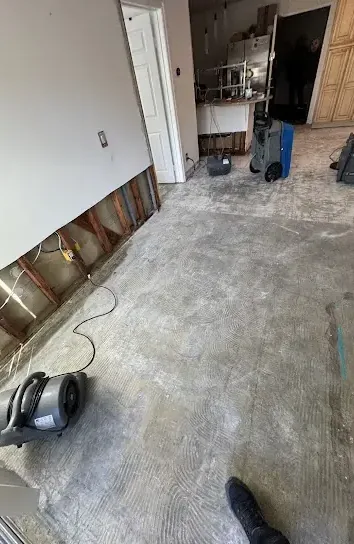
First moves for structural drying and dehumidification
- 1
Read the surfaces
Take moisture readings to mark each wet area.
- 2
Place equipment
Air movers and dehumidifiers go where readings call for them.
- 3
Check each visit
Readings are repeated and the equipment moved.
- 4
Sign off dry
Equipment leaves when readings reach the dry standard.
The standard behind every structural drying and dehumidification job
Dispatch at any hour
Active water is treated as urgent around the clock, because drywall and pad keep wicking until extraction starts.
Dried to a reading
The drying team works to the IICRC S500 standard and pulls equipment only when the meters say dry.
A file the adjuster can use
Moisture maps, daily psychrometric logs and timestamped photos are taken before anything is torn out.
Built for Piedmont houses
Clay lots, walkout basements, crawl spaces and attic air handlers shape how water moves in these homes.
What does structural drying and dehumidification cost in Cumming, GA?
Structural drying for one room, Class 1 or 2, commonly costs $1,200 to $2,800. Several rooms at Class 3 run $2,800 to $5,500, and Class 4 materials like hardwood or concrete can reach $5,500 to $8,000 or more.
| Size of the loss | Typical range | What it usually covers |
|---|---|---|
| One room, Class 1 or 2 | $1,200 to $2,800 | Equipment set, Daily readings, Dry sign-off |
| Several rooms, Class 3 | $2,800 to $5,500 | Multiple zones, Extended run, Wall cavities dried |
| Class 4 materials | $5,500 to $8,000+ | Dense materials, Low-humidity drying, Long monitoring |
Ranges are typical, not a quote: the water category, square footage, material class and how fast drying started move the number most. Run the water damage cost calculator for a closer planning figure.
The structural drying and dehumidification process from first reading to dry
- 1
Read
Meters map the wet materials.
- 2
Place
Equipment goes where readings point.
- 3
Adjust
Units move as the numbers change.
- 4
Release
Equipment leaves at the dry standard.
Drying is more than running fans. Moisture hides in framing and under floors, and the equipment has to move wet air out and dry air in. Cumming housing mixes townhomes, estate homes and neighborhoods where many homes date from the 1990s and 2000s, so plans are set house by house.
How the equipment is placed
Air movers push air across wet surfaces to lift moisture, and dehumidifiers pull it out of the room. Placement changes after each reading, so the first setup is rarely the last one.
- Air movers aimed at each wet wall or floor section
- Dehumidifiers sized to the volume of the room
- Doors and vents managed to hold dry air
Wall cavities and subfloors are dried through small holes or lifted baseboards, so less has to be torn out.
Wet walls and floors that need to dry for real? Call for a measured drying plan.
(888) 532-4616Cumming drying equipment helpDrying classes and targets
Class 1 and 2 jobs involve a limited area or materials that absorb moderately, Class 3 involves water that came from above and soaked ceilings, walls and insulation, and Class 4 involves dense materials like hardwood and concrete.
- Class 1 or 2: one room, light absorption
- Class 3: several rooms, water from above
- Class 4: dense materials held for longer
Dry means measured
A wall that feels dry can still read wet at depth. Equipment leaves only after the meter reads the same as an untouched part of the house.
Where drying fits in
Structural drying follows water extraction and sits behind almost every other service, from burst pipe water damage to storm and flash flood cleanup, and the rest of the Cumming water damage services end the same way.
Structural drying and dehumidification across Cumming and nearby communities
One dispatch covers every neighborhood listed here, around the clock.
Drying plans cover Cumming townhomes in Vickery, larger houses in Windermere and Creekstone Estates, and neighborhoods with many homes from the 1990s and 2000s, along with nearby Forsyth County streets.
The same service nearby: structural drying and dehumidification in Flowery Branch, Sugar Hill, Buford.
Structural Drying and Dehumidification questions in Cumming, GA
How long does structural drying take?
Usually several days, though it depends on the materials and how much water they took on. The job ends when readings reach the dry standard, not on a set date.
Why is the drying equipment so noisy?
The equipment moves a lot of air and pulls water out of it, which makes noise. The sound is a sign that moisture is leaving the structure.
Can the walls stay up while they dry?
Often yes. Small holes or lifted baseboards let air into the cavity, and meters show whether the drywall and insulation inside are drying. Wet insulation or soft drywall is still removed.
Does mold grow while the drying is under way?
It can start within 24 to 48 hours in wet materials, which is why drying starts early. Controlled humidity during the drying run helps keep it from taking hold.
Is structural drying covered by insurance?
When the water came from a sudden covered event, the drying is usually part of the claim. Daily logs and final readings show the adjuster what was done and why.
Surface looks dry but the framing is not? Get it checked.
The drying team sets air movers and dehumidifiers by moisture readings, adjusts them at each visit and removes them only when the structure is dry.