Structural Drying and Dehumidification in Buford, GA
Pulling out the standing water is only half the job. The drying team in Buford uses air movers, dehumidifiers and meter readings to take moisture out of drywall, framing and subfloor.
(888) 532-4616Walls and floors still damp? Call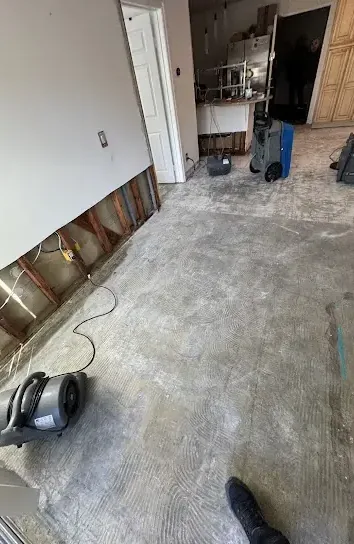
First moves for structural drying and dehumidification
- 1
Keep doors closed
Closed rooms let dehumidifiers work on less air.
- 2
Leave equipment running
Do not turn units off between visits.
- 3
Hold the thermostat
Keep the air conditioning set as the crew advises.
- 4
Protect belongings
Keep items off wet floors while they dry.
The standard behind every structural drying and dehumidification job
Dispatch at any hour
Active water is treated as urgent around the clock, because drywall and pad keep wicking until extraction starts.
Dried to a reading
The drying team works to the IICRC S500 standard and pulls equipment only when the meters say dry.
A file the adjuster can use
Moisture maps, daily psychrometric logs and timestamped photos are taken before anything is torn out.
Built for Piedmont houses
Clay lots, walkout basements, crawl spaces and attic air handlers shape how water moves in these homes.
What does structural drying and dehumidification cost in Buford, GA?
Drying one room to Class 1 or 2 standards runs $1,200 to $2,800, and several rooms at Class 3 run $2,800 to $5,500. Class 4 materials such as hardwood, plaster or concrete can reach $5,500 to $8,000 or more.
| Size of the loss | Typical range | What it usually covers |
|---|---|---|
| One room, Class 1 or 2 | $1,200 to $2,800 | Air movers set, Dehumidifier running, Readings logged |
| Several rooms, Class 3 | $2,800 to $5,500 | Wall cavities opened, Larger equipment run, Daily readings |
| Class 4 materials | $5,500 to $8,000+ | Dense materials treated, Extended drying run, Specialty equipment |
Ranges are typical, not a quote: the water category, square footage, material class and how fast drying started move the number most. Run the water damage cost calculator for a closer planning figure.
The structural drying and dehumidification process from first reading to dry
- 1
Map
Meters mark where moisture sits.
- 2
Place
Air movers and dehumidifiers set up.
- 3
Monitor
Readings logged every visit.
- 4
Release
Equipment removed once all spots read dry.
After water extraction, the building is still wet. Drywall, framing and subfloor hold moisture inside the material, and it only comes out when warm, moving, dehumidified air passes over them. That second phase is structural drying.
How the equipment works
Air movers push dry air across wet surfaces to lift moisture out of the material. Dehumidifiers pull that moisture out of the air so it does not settle somewhere else.
- Air movers aimed along walls and floors
- Dehumidifiers sized to the room volume
- Wall cavities opened or vented where needed
Placement follows the meter, not a template. Readings on drywall, studs and subfloor show where moisture is heaviest, and equipment is moved as areas dry.
Surfaces dry to the touch but still damp inside? Dry-feeling walls can still hold water.
(888) 532-4616Start the structural drying planKnowing when it is dry
Drying ends when readings match a dry reference taken from an unaffected part of the house, not when the room feels dry. Daily logs show the trend and the stopping point.
- Readings taken on the same spots daily
- Equipment removed only after all spots read dry
- Drywall and framing checked before rebuilding
Why waiting is risky
Damp framing can grow mold after 24 to 48 hours, and trapped moisture can swell trim and cup flooring. Starting drying right after extraction closes that window.
Hard-to-dry spots
Wall cavities, space under cabinets and areas behind baseboards stay wet after the visible water is gone. Where drying follows a burst pipe, see burst pipe water damage, and insulation that stays wet is removed rather than dried in place.
Structural drying and dehumidification across Buford and nearby communities
One dispatch covers every neighborhood listed here, around the clock.
Drying equipment is set up across Buford, from the historic downtown along Main Street and Shadburn Avenue to Hosch Reserve, Edenmoor and the rest of the newer communities, in both 30518 and 30519.
The same service nearby: structural drying and dehumidification in Flowery Branch, Sugar Hill, Suwanee.
Structural Drying and Dehumidification questions in Buford, GA
Why does a house need drying after the water is gone?
Water soaks into drywall, framing and subfloor, where it stays after the surface looks dry. Without drying equipment that moisture lingers and invites mold, swelling and odor.
What do Class 1 through 4 mean?
The class describes how much of the building got wet and how slowly the materials release water. Class 1 or 2 is limited to part of a room, Class 3 is water from above, and Class 4 is dense material like hardwood or plaster.
How do you know when a room is dry?
Meters read moisture in drywall, wood and subfloor, and the results are compared with a dry sample from an unaffected area. Drying stops when the wet spots match that reference.
Does the equipment run all day?
The equipment runs continuously until the readings say the materials are dry, which is the noisy part of the job. The drying team checks the setup at each visit and moves units as areas dry.
Does insurance pay for structural drying?
When the water event itself is covered, drying is generally covered too, and the daily moisture logs support that claim. Policies differ, so the adjuster should see the readings and photos.
Water gone but walls still wet? Start the drying.
Air movers and dehumidifiers go in, readings are logged daily, and drying ends only when materials read dry.