Structural Drying in Suwanee, GA
Once the standing water is gone, moisture still sits inside framing, drywall and subfloors, and the drying team uses air movers, dehumidifiers and daily readings to bring every material back to dry.
(888) 532-4616Call about drying the structure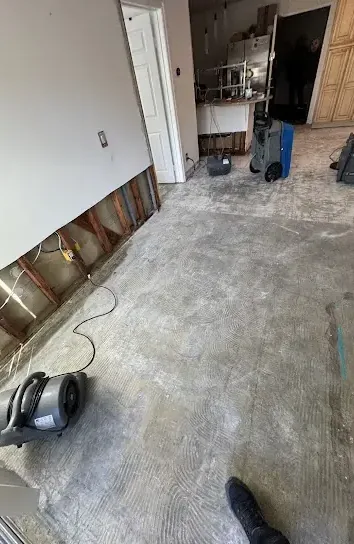
First moves for structural drying and dehumidification
- 1
Extract first
Standing water has to go before drying works.
- 2
Keep the home closed
Shut windows so humid air stays out.
- 3
Leave equipment running
Do not switch off the units between visits.
- 4
Call for a plan
Call now, any hour, about the wet rooms.
The standard behind every structural drying and dehumidification job
Dispatch at any hour
Active water is treated as urgent around the clock, because drywall and pad keep wicking until extraction starts.
Dried to a reading
The drying team works to the IICRC S500 standard and pulls equipment only when the meters say dry.
A file the adjuster can use
Moisture maps, daily psychrometric logs and timestamped photos are taken before anything is torn out.
Built for Piedmont houses
Clay lots, walkout basements, crawl spaces and attic air handlers shape how water moves in these homes.
What does structural drying and dehumidification cost in Suwanee, GA?
Drying one room at Class 1 or 2 usually costs $1,200 to $2,800. Several rooms at Class 3 run $2,800 to $5,500, and Class 4 materials such as saturated hardwood or plaster reach $5,500 to $8,000+ because they release moisture slowly.
| Size of the loss | Typical range | What it usually covers |
|---|---|---|
| One room, Class 1 or 2 | $1,200 to $2,800 | Air movers and dehumidifier, Daily moisture readings, Final dry check |
| Several rooms, Class 3 | $2,800 to $5,500 | Wall cavities opened, Extra dehumidification, Documented progress |
| Class 4 materials | $5,500 to $8,000+ | Specialty drying equipment, Extended monitoring, Detailed final report |
Ranges are typical, not a quote: the water category, square footage, material class and how fast drying started move the number most. Run the water damage cost calculator for a closer planning figure.
The structural drying and dehumidification process from first reading to dry
- 1
Map
Meters locate every wet material.
- 2
Set
Equipment is placed room by room.
- 3
Read
Moisture is measured each visit.
- 4
Release
Equipment leaves at the dry target.
Drying is where most of a water damage job is won or lost. Extraction removes the visible water, but framing, drywall and subfloors keep moisture inside them, and only controlled airflow and dehumidification bring it out of homes in Suwanee.
How the equipment is placed
Air movers are aimed along walls and floors to push dry air across wet surfaces, while dehumidifiers pull the moisture out of the room so it cannot settle back into the materials.
- Air movers placed by room size
- Dehumidifiers matched to the volume of air
- Wall and floor cavities opened when needed
Equipment is adjusted at each visit, because a setup that works on the first day rarely suits the third.
Wet framing and floors do not dry on their own, so call and describe how far the water spread.
(888) 532-4616Call about drying the wet roomsWhen drying follows a creek flood or sewer event
After floodwater or sewage has been extracted and the porous materials removed, the remaining framing is dried the same way. Storm flood cleanup and sewage backup cleanup both hand off to this stage.
- Framing dried after contaminated materials are out
- Subfloors dried from above and below when possible
- Cavity drying when wall bases stayed wet
Measured, not guessed
Readings on wet materials are compared with readings on dry ones in the same home, so the target is real. Equipment comes out only when the numbers match.
Why stopping early costs more
Pulling equipment before materials are dry leaves moisture trapped in framing, where it can lead to mold and swollen wood. A final reading and photo record closes the job and supports the claim.
Structural drying and dehumidification across Suwanee and nearby communities
One dispatch covers every neighborhood listed here, around the clock.
Structural drying runs in homes across the 30024 ZIP code, from the streets near Peachtree Ridge High School and Collins Hill High School to those by Town Center, anywhere extraction or tear out has left materials wet.
The same service nearby: structural drying and dehumidification in Flowery Branch, Sugar Hill, Buford.
Structural Drying and Dehumidification questions in Suwanee, GA
How long does drying last?
Drying lasts as long as the slowest material needs. Wet hardwood and plaster dry slowly, while painted drywall dries quickly, so meter readings, not the calendar, set the finish.
Why is the equipment so loud and warm?
Dehumidifiers and air movers run continuously and give off heat, which also speeds evaporation. The noise and warmth are signs the drying is working.
Can the home be occupied during drying?
Often yes, with some rooms closed off, though the equipment is loud and the air can feel warm. After sewage or floodwater the affected area should stay vacant until it is cleared.
Do the walls have to be opened?
Only when readings show wet insulation or framing that air cannot reach. Small access holes at the base of a wall are sometimes enough to let drying air in.
How is dryness confirmed?
A moisture meter reading on each wet material is compared with a reading from a dry area of the same home. When the two match, the material has reached the dry target.
How much does structural drying cost?
One room at Class 1 or 2 usually runs $1,200 to $2,800, several rooms at Class 3 $2,800 to $5,500, and Class 4 materials $5,500 to $8,000+, depending on the materials involved.
Dry the structure before the damage spreads
The drying team sets equipment by room, reads moisture each visit and removes it only when materials reach the dry target.