Structural Drying and Dehumidification in Gainesville, GA
Pulling out the water is only half the job. The drying team then dries the framing, subfloor and walls with air movers and dehumidifiers, checking meters until each material reaches a dry target.
(888) 532-4616Walls and floors still wet? Call now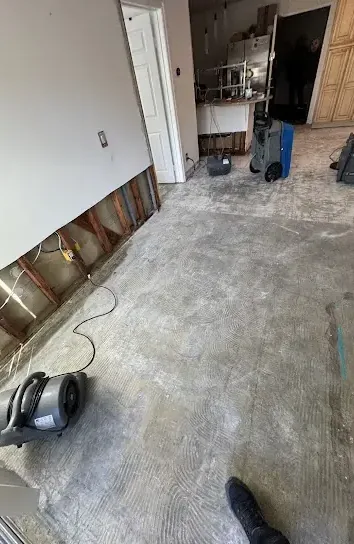
First moves for structural drying and dehumidification
- 1
Keep equipment running
Do not switch off air movers or dehumidifiers.
- 2
Close doors
A closed room helps the dehumidifier work.
- 3
Do not move gear
The layout is planned from readings.
- 4
Keep the records
Save every visit's moisture log.
The standard behind every structural drying and dehumidification job
Dispatch at any hour
Active water is treated as urgent around the clock, because drywall and pad keep wicking until extraction starts.
Dried to a reading
The drying team works to the IICRC S500 standard and pulls equipment only when the meters say dry.
A file the adjuster can use
Moisture maps, daily psychrometric logs and timestamped photos are taken before anything is torn out.
Built for Piedmont houses
Clay lots, walkout basements, crawl spaces and attic air handlers shape how water moves in these homes.
What does structural drying and dehumidification cost in Gainesville, GA?
Expect roughly $1,200 to $8,000 or more for structural drying. One room is the low end and materials that hold water deep, such as hardwood or concrete, are the high end, with equipment time and the number of rooms setting the range.
| Size of the loss | Typical range | What it usually covers |
|---|---|---|
| One room, Class 1 or 2 | $1,200 to $2,800 | Air movers placed, Dehumidifier running, Meter checks |
| Several rooms, Class 3 | $2,800 to $5,500 | Wall cavities dried, Floor drying, Daily readings |
| Class 4 materials | $5,500 to $8,000+ | Dense materials dried, Extended equipment run, Verified dry target |
Ranges are typical, not a quote: the water category, square footage, material class and how fast drying started move the number most. Run the water damage cost calculator for a closer planning figure.
The structural drying and dehumidification process from first reading to dry
- 1
Map
Meters and thermal imaging find wet areas.
- 2
Set up
Air movers and dehumidifiers go in.
- 3
Monitor
Readings are taken and gear adjusted.
- 4
Verify
Equipment leaves once materials read dry.
Structural drying begins once the standing water is gone. A storm like the one on July 24, 2026, when almost seven inches of rain fell on Hall County, can leave walls, subfloors and framing wet long after the puddles are pumped out.
What drying actually involves
Air movers push dry air across wet surfaces, and dehumidifiers pull the moisture out of that air. The two work together, and neither does the job alone.
- Air movers placed along wet surfaces
- Dehumidifiers sized to the space
- Containment to keep drying airflow focused
Equipment is not left on a guess. Meters give a number for each material, and the crew moves or adds machines at every visit until the numbers fall.
Walls and floors still wet after the water is gone? Moisture left inside keeps causing damage.
(888) 532-4616Get walls driedClass of loss and materials
Drywall and carpet release water fast, while hardwood, plaster and concrete hold it. The drying plan changes with the material, and dense materials usually set how long the equipment runs.
- Wall cavities opened to dry from inside
- Floor cavities treated with drying panels
- Hard materials checked for deep moisture
A dry-looking wall can still be wet
Surface paint hides moisture inside drywall and insulation. A thermal camera and a pin meter find the wet spots the eye misses, which keeps a damp wall from turning into an odor or a stain later.
Finishing and the file
When every material reads dry, the equipment comes out and the readings are saved with photos for the insurer. Water extraction is the step that comes first, and storm flood cleanup covers the removal of contaminated materials before drying.
Structural drying and dehumidification across Gainesville and nearby communities
One dispatch covers every neighborhood listed here, around the clock.
Structural drying runs in homes across the city, including Downtown Gainesville, the Lake Lanier shoreline and the neighborhoods that make up ZIP 30506, wherever walls and floors still read wet.
The same service nearby: structural drying and dehumidification in Flowery Branch, Buford, Sugar Hill.
Structural Drying and Dehumidification questions in Gainesville, GA
How long will the equipment run?
It runs until the readings reach a dry target, and that depends on the material and the amount of water. The crew checks the meters at each visit rather than setting a fixed schedule.
Why is the equipment so loud and warm?
Air movers and dehumidifiers push and heat the air to pull moisture out of wood and drywall. The noise and warmth are signs the drying is working, and the readings drop as it does.
Can I open windows instead?
Outside air can be damp, especially after a storm, so opening windows can slow drying. A closed room with a dehumidifier gives the crew control of the moisture.
Does everything wet get removed?
No. Hardwood, tile, concrete and framing are usually dried in place, while carpet pad, insulation and soaked drywall often come out. Readings and the water category decide.
Is drying cheaper than replacing?
Drying in place usually costs less than tearing out and replacing framing and finishes. Cost depends on rooms, materials and equipment time rather than a flat rate.
Wet walls in Gainesville? Get them dried to a reading.
The crew places the equipment, checks the meters at every visit and removes it only when the materials read dry.